Classification: Neural
Lab setup
First, make sure you have completed the initial setup.
If you are part of a course
-
Open Terminal. Run the update command to make sure you have the latest code.
$ mwc update -
Move to this lab's directory.
$ cd ~/Desktop/making_with_code/shuyuan/labs/classification_neural
If you are working on your own
-
Move to your MWC directory.
$ cd ~/Desktop/making_with_code -
Get a copy of this lab's materials.
git clone https://git.makingwithcode.org/mwc/lab_classification_neural.git

In the previous lab you built a spam classifier in three stages: you wrote rules by hand, then handed the model a handful of features you designed, and finally let it choose from every word in the vocabulary and learn which ones mattered. Each stage traded human cleverness for trust in the learning algorithm—and each one did better than the last.
Now we face a harder problem: classifying handwritten digits. MNIST is the classic benchmark dataset of handwritten digits. It contains 70,000 grayscale images, each 28×28 pixels. Each pixel's brightness is stored as a number between 0 (black) and 1 (white), so the input for each example is a 2-dimensional array (28×28) of these brightness values—784 numbers in all.
Classification with features
💻 Load and visualize some examples:
$ digits --exploreThis prints a few digits as ASCII art and shows the label distribution. (Add a
number to see more examples, for example digits --explore 10)
In the spam lab, you designed features like "contains_free" and "number of exclamation marks." You knew what patterns to look for because you had read lots of spam messages.
What features might you design for handwritten digits? Some examples might include:
- Total number of bright pixels
- The fraction of bright pixels in the top half vs. the bottom half
- Pixel brightness in different parts of the image
- Whether the digit has a closed loop
Implement some of your features in models/features.py (look for
the extract_features method) and evaluate the result:
$ digits models.features.FeatureClassifier -aEvery pixel a feature
Let's borrow an intuition from the previous lab--instead of
guessing which words mattered, you made every word a feature and
let logistic regression to sort out which ones were useful. Here, you could
just hand all 784 raw pixel
values straight to LogisticRegression and let it learn a weight for each one.
👁
Open models/pixels.py. There's no FeatureExtractor, no
DictVectorizer, no Pipeline—just a LogisticRegression that takes the
pixel arrays directly:
class PixelClassifier:
def fit(self, X, y):
self._classifier = LogisticRegression(max_iter=1000)
self._classifier.fit(X, y)
return self
def predict(self, X):
return self._classifier.predict(X)💻 Run it:
$ digits models.pixels.PixelClassifierArtificial Neural Networks
Learned features
Think back to a feature you might design for digit classification—say, the average brightness in the left quarter of the image. You could write it as a function that takes in all 784 pixel values and returns a single number:
    def extract_features(self, pixels):
        img = pixels.reshape(28, 28)
        return {
            "left_brightness": float(img[:, :7].mean())
        }
Look at what that function actually does: it multiplies each pixel by either 1 (if it's in the left quarter) or 0 (if it isn't), adds up the results, and scales them down. That's a weighted sum—the same calculation that has driven every classifier you've built so far—except here you chose the weights, by hand, before training even began: 1 for the pixels you decided mattered, 0 for the rest.
But weights don't have to be chosen by hand. You already know how to learn them—logistic regression does it through training, starting from nothing and gradually adjusting. So: what if, instead of deciding in advance which of the 784 pixels should count toward a feature, the model started with random weights for all of them and adjusted those weights through training—the very same way it already learns to weigh the features at the end of the pipeline?
Now imagine doing that many times over: building a whole bank of these candidate-feature functions, each starting from its own random weights, each free to become whatever weighted combination of pixels turns out to help. Train the entire system together, and the model isn't just learning how to weigh a set of features you handed it—it's learning what those features should be in the first place.
That's the idea behind a multi-layer perceptron (MLP): place a layer of these learned-feature functions in front of the final decision-making layer. It's the same move this lab keeps making, taken one level deeper—replacing a step you used to do by hand with something the model works out for itself.
Structure of a single neuron
Each of those candidate-feature functions is called a neuron (originally inspired by the structure of neurons in your brain). A neuron takes several inputs, multiplies each by a (learnable) weight, adds them up along with a bias term, and passes the result through an activation function:
$$ \text{output} = \text{activation}(x_1 w_1 + x_2 w_2 + \cdots + x_n w_n + b) $$
If "sum + bias" looks familiar, it should—that's the calculation that drove every classifier in the spam lab and the pixel classifier above. The only new ingredient is the activation function, which processes the neuron's output. (We won't go into the details here.)
A neuron, in other words, is a learned feature: a measurement the network
invented for itself, the same way left_third_brightness was a measurement you
invented for yourself. The difference is that you can name and explain your
feature, while a learned one is just whatever pile of weights happened to
reduce the loss.
A single hidden layer
The simplest possible MLP places one layer of neurons—a hidden layer—between the input and the output:
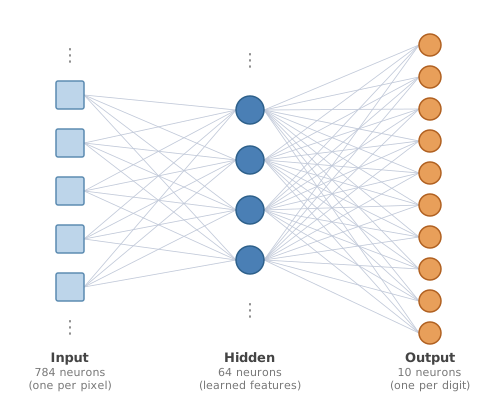
Each of the 64 hidden neurons computes its own weighted sum of all 784 pixel values, applies its activation function, and passes the result forward. Then each neuron in the output layer combines those 64 learned features into a probability that the image is a particular digit.
💻 Train an MLP with 32 neurons:
$ digits models.mlp.MLPClassifier --hidden 32You should see accuracy climb with each epoch:
Training MLP (hidden_sizes=(32,), epochs=10)
  epoch  1/10  loss=1.125  val_accuracy=0.854  2.1s
  epoch  2/10  loss=0.441  val_accuracy=0.895  2.0s
  ...
  epoch 10/10  loss=0.168  val_accuracy=0.924  2.0s
💻 Try a few other hidden layer sizes and training lengths:
$ digits models.mlp.MLPClassifier --hidden 16
$ digits models.mlp.MLPClassifier --hidden 256
$ digits models.mlp.MLPClassifier --hidden 64 --epochs 20Multi-layer perceptrons
Nothing requires stopping at one hidden layer. A multi-layer perceptron stacks several of them, so that one layer's output becomes the next layer's input:
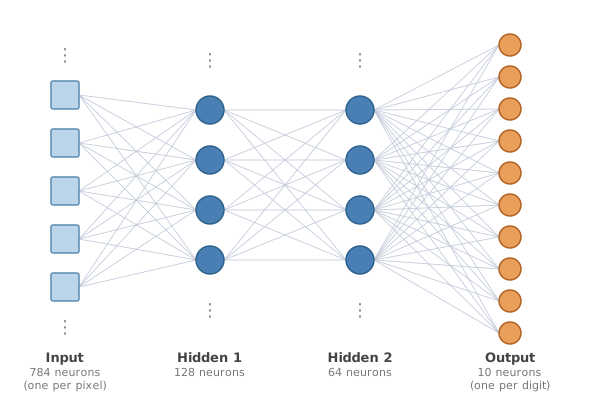
Each additional layer gets to learn features of the previous layer's features—combinations of combinations. A first hidden layer might settle on something like edges and curves; a second can combine those into more complex shapes; and so on, until the output layer has rich enough material to make a confident decision.
Backpropagation
How does an MLP learn its weights—now spread across several layers instead of just one? The training algorithm is called backpropagation, and—like logistic regression—it is built from an idea you already understand: start with a bad model, measure how bad it is, and nudge it to be a little less bad, over and over.
- Start by choosing random numbers for every weight, in every layer.
- Measure how bad the model is. Take each image in the training set, pass it through the network layer by layer, and compare the prediction it produces to the true label. As in logistic regression, each wrong (or under-confident) prediction earns a penalty, and all the penalties get added up into a single loss—just now averaged over ten possible digits instead of two message classes.
- Use calculus to figure out which direction to nudge each weight to bring that loss down. Here is the wrinkle a layered network adds: a weight in the first layer affects the final answer only indirectly—its effect passes through every layer that comes after it. So the algorithm works backward through the network: first it figures out how wrong the output layer's guesses were, then uses that to work out how much blame each neuron in the hidden layer just before it deserves, then steps back again to the layer before that, assigning blame and computing nudges all the way back to the first layer. That backward pass through the layers is what gives the algorithm its name: backpropagation.
- Repeat steps 2 and 3 for thousands of examples.
💻 Train a deeper MLP, with two hidden layers:
$ digits models.mlp.MLPClassifier --hidden 128 64Training MLP (hidden_sizes=(128, 64), epochs=10)
epoch 1/10 loss=0.852 val_accuracy=0.890 2.3s
epoch 2/10 loss=0.321 val_accuracy=0.905 2.2s
epoch 3/10 loss=0.246 val_accuracy=0.917 2.2s
...
epoch 10/10 loss=0.054 val_accuracy=0.947 2.2s💻 Compare it to your best single-hidden-layer result, and try a few more architectures. Hidden layers can be any size you want, but multiples of 2 are most efficient.
$ digits models.mlp.MLPClassifier --hidden 256 128 64
$ digits models.mlp.MLPClassifier --hidden 64 64 --epochs 20Convolutional Neural Networks
Detecting local patterns
The MLP can learn its own features—but it learns them by looking at the whole 784-pixel image at once. It would be better if the model could learn features about parts of the image: small, local patterns like straight lines, loops, corners, and curves.
If you looked at just a small patch of an image, you could probably hand-write a detector for patterns like these—"is there a horizontal edge in this corner of the patch?" is the kind of question you could answer by comparing a handful of neighboring pixel values. But you already know how that story ends: hand-written features lose to learned ones.
So: what if the model learned these small-patch pattern-detectors itself—and then went looking for each one everywhere in the image, not just in one fixed spot? That's the idea behind a convolutional neural network (CNN).
Kernels
A convolutional layer applies a small function (called a kernel) across the image. The kernel slides over every position and multiplies the current pixels by the kernel's weights, transforming the pixel values into an activation map that shows where that pattern appears.
For example, a horizontal-edge-detecting kernel might produce high values wherever there is a horizontal line in the image, and low values elsewhere. The network doesn't know in advance which patterns will be useful—the kernel values themselves are learned, by backpropagation, the same way features in hidden layers of the ANN were learned.
The kernel size controls how large a patch the kernel examines at each position. A 3×3 kernel looks at a 3×3 patch of pixels; a 5×5 kernel sees more context but uses more parameters and is slower to compute. Smaller kernels (3×3) are most common in modern CNNs.
Stride controls how far the kernel moves at each step. Stride 1 means it moves one pixel at a time. With stride 2, it skips every other position—so a kernel applied to a 28×28 image with stride 2 produces a roughly 13×13 activation map instead of a 26×26 one. Each additional convolutional layer with stride 2 halves the spatial dimensions again.
You may already recognize this idea: it's the same as the step argument in
range. range(0, 28, 1) visits every position; range(0, 28, 2) skips
every other one.
Train a CNN
💻 Train the CNN:
$ digits models.cnn.CNNClassifierTraining CNN (epochs=5)
epoch 1/5 loss=0.628 val_accuracy=0.938 8.3s
epoch 2/5 loss=0.145 val_accuracy=0.969 8.1s
...
epoch 5/5 loss=0.048 val_accuracy=0.971 8.0sTraining takes longer than the MLP (a few minutes on a laptop). You can reduce epochs to get results faster, at some cost to accuracy:
$ digits models.cnn.CNNClassifier --epochs 3By default, digits trains on 10,000 examples to keep iteration fast. Add
--full to train on all 60,000 examples in MNIST—accuracy goes up, but
training takes roughly six times as long:
$ digits models.cnn.CNNClassifier --fullTry it on your own handwriting
Once you have a CNN you're happy with, it's worth saving it—training takes several minutes, and you don't want to repeat that every time you want to use the model.
💻 Save your trained model's configuration and weights:
$ digits models.cnn.CNNClassifier --save cnnNext time, you can load the saved model by name instead of re-training:
$ digits cnn💻 Now point your trained classifier at the real world. Find a piece of paper, write a digit on it in thick marker, and hold it up to your computer's camera:
$ digits cnn --runA window opens showing your camera's view with a green box drawn on it.
Whatever falls inside that box is converted into a 28×28 image—the same format
as the MNIST images you trained on—and classified on the spot. The terminal
prints the predicted digit and the model's confidence, updating live as you
move the paper around. Press q (with the camera window focused) to quit.